
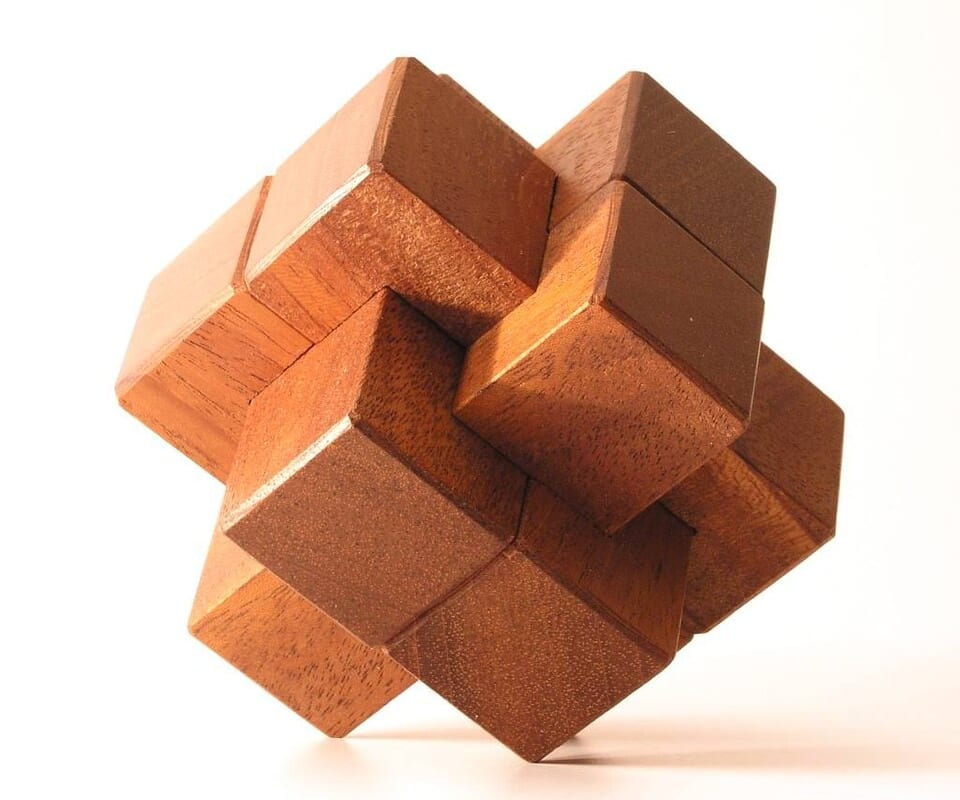
3D Metal & Wood Puzzles
From traditional wooden burr puzzles to Hanayama's beautifully crafted metal designs, these three-dimensional challenges have a way of making you look at things differently. Sometimes the hardest part isn't putting the pieces together. It's figuring out how they came apart in the first place.
Unlike many traditional tavern puzzles, three-dimensional mechanical puzzles often challenge you to figure out how solid pieces fit together, move around one another, or come apart. A piece might slide in one direction but refuse to move in another. Sometimes you have to reposition several pieces before anything starts to make sense. What looks like a simple collection of wooden blocks or metal shapes can turn into a surprisingly complicated challenge.
One of the best-known examples is the burr puzzle, named for its resemblance to the prickly seed cases found on certain plants. The classic six-piece version consists of notched wooden sticks that interlock to form a three-dimensional shape. No glue or fasteners are needed; the pieces hold one another in place. Some burr puzzles are fairly straightforward, while others require a surprisingly complicated sequence of movements to take apart. Modern designers have even used computer programs to develop increasingly challenging arrangements.
Hanayama takes a somewhat different approach with its cast-metal puzzle collection. These puzzles are as interesting to look at as they are to solve. The pieces have a nice weight to them, the finishes are smooth, and the designs range from simple-looking shapes to some pretty elaborate constructions. What I particularly like about them is that they feel like small works of art. Even when you're not trying to solve one, they're interesting objects to pick up and examine.
The Foundation
The Burr Puzzle
Six pieces of wood. More possibilities than you might expect.
The six-piece burr is one of the best-known types of interlocking mechanical puzzles. It's usually made from six notched wooden pieces that fit together at right angles, forming a compact, three-dimensional shape. The pieces hold one another in place without glue or fasteners. Depending on the design, taking one apart might be fairly easy or require a carefully planned series of moves. Of course, getting everything back together can be another challenge entirely.
Interlocking wooden puzzles have been around for centuries, although their exact origins aren't always easy to trace. They're sometimes associated with traditional Chinese craftsmanship, but many of the claims about their earliest history are difficult to verify. What we do know is that wooden interlocking puzzles became popular in Europe during the 19th century, when advances in manufacturing made them more widely available. Their appeal is easy to understand: a few carefully shaped pieces of wood can create a surprisingly complicated challenge.
Modern puzzle designers have taken the traditional burr puzzle to an entirely different level. Using computers to explore different combinations of notches and interlocking pieces, they've developed designs that would be extremely difficult to work out by hand. Puzzle designer Bill Cutler helped demonstrate just how many possibilities exist within the familiar six-piece arrangement. Some modern burr puzzles require dozens of carefully sequenced moves just to remove the first piece. That's a remarkable amount of complexity for something made from six pieces of wood.
Six pieces of wood. No moving parts, no hidden mechanisms, and sometimes no obvious way to take them apart. That's what makes a good burr puzzle so interesting.
Timeline
Early Commercial Documentation: A six-piece interlocking puzzle appears in a German toy catalogue published by G. H. Bestelmeier. This is one of the earliest well-documented examples of the familiar burr puzzle. Its actual invention may be considerably older.
The Altekruse Puzzle: A more elaborate interlocking puzzle designed by William Altekruse receives a US patent. Its twelve pieces demonstrate how the traditional burr concept can be expanded into more complicated constructions.
Burr Puzzles in Print: Professor Hoffmann includes a traditional six-piece interlocking puzzle in his book Puzzles Old and New, helping document the designs that were popular with puzzle enthusiasts in the late Victorian era.
The Burr Puzzle Gets Its Name: Edwin M. Wyatt publishes Puzzles in Wood, featuring numerous interlocking designs and helping establish the term 'burr puzzle' in the published literature.
Bill Cutler's Computer Analysis: Puzzle designer Bill Cutler uses computer programs to examine more than 35 billion possible standard six-piece burr configurations. His work reveals just how much complexity can be hidden inside this familiar wooden puzzle.
Modern Puzzle Design: Computer-assisted design and specialized puzzle-solving software continue to give designers new ways to develop and test interlocking puzzles. The results range from traditional six-piece burrs to remarkably complicated multi-piece constructions.
The Art Object
Hanayama & Cast Metal
When a puzzle is just as interesting to look at as it is to solve.

Hanayama's cast-metal puzzles bring something a little different to the world of mechanical puzzles. Developed in Japan, the series includes designs by puzzle creators such as Nob Yoshigahara, whose work helped shape the modern collection. Unlike many traditional wooden puzzles, these are often just as interesting to look at as they are to solve. Their smooth surfaces, unusual shapes, and solid metal construction make them feel like small sculptures. They're the sort of puzzles you might leave sitting on your desk, partly because they look nice and partly because you haven't figured them out yet.
Hanayama rates its puzzles on a difficulty scale from 1 to 6, with 1 being the easiest and 6 the most challenging. It's a useful guide when choosing a puzzle, although difficulty can be pretty subjective. Something one person figures out in a few minutes might keep someone else occupied for hours. The higher-rated puzzles often require a combination of patience, careful observation, and a willingness to try approaches that don't seem particularly promising at first.
One of the things I particularly appreciate about Hanayama puzzles is how the design and the solution work together. The curves, angles, and openings aren't just there to make the puzzle look interesting. They're often essential to figuring out how the pieces move and fit together. A slight change in position can make all the difference between two pieces being completely stuck and sliding apart. It's a good example of how much thought can go into something that fits in the palm of your hand.
A good Hanayama puzzle looks great sitting on your desk. A really good one might stay there for weeks while you try to figure it out.
Timeline
Hanayama introduces its first three cast-metal puzzles in Japan: Cast Key, Cast A.B.C., and Cast Star. Working with renowned puzzle designer Nob Yoshigahara, the company begins developing a collection that combines traditional mechanical puzzle ideas with modern manufacturing and design.
These are generally the most approachable puzzles in the collection and a good place to start if you're new to Hanayama. Don't let the lower ratings fool you, though. Even a Level 1 or 2 puzzle can leave you scratching your head until you spot that one little detail you've been overlooking.
This is where things start getting particularly interesting. Levels 3 and 4 offer a nice balance of challenge and enjoyment, often requiring several attempts and a little experimentation before everything clicks. They're a good choice if you already have some experience with mechanical puzzles and want something that will keep you occupied for a while.
These are Hanayama's most challenging puzzles, and some can take quite a bit of time to figure out. You'll need patience, careful observation, and probably a willingness to put the puzzle down and come back to it later. The solution might be surprisingly elegant once you discover it, but getting there is another matter entirely.
What started with just three puzzles has grown into a collection of more than 60 designs, featuring the work of puzzle creators from around the world. Hanayama continues to introduce new puzzles while bringing back selected older designs. There's a wide variety of shapes, mechanisms, and difficulty levels, giving collectors plenty to explore.
The Collection
Building a 3D Puzzle Collection
Where to begin, what to look for, and how your collection might grow.
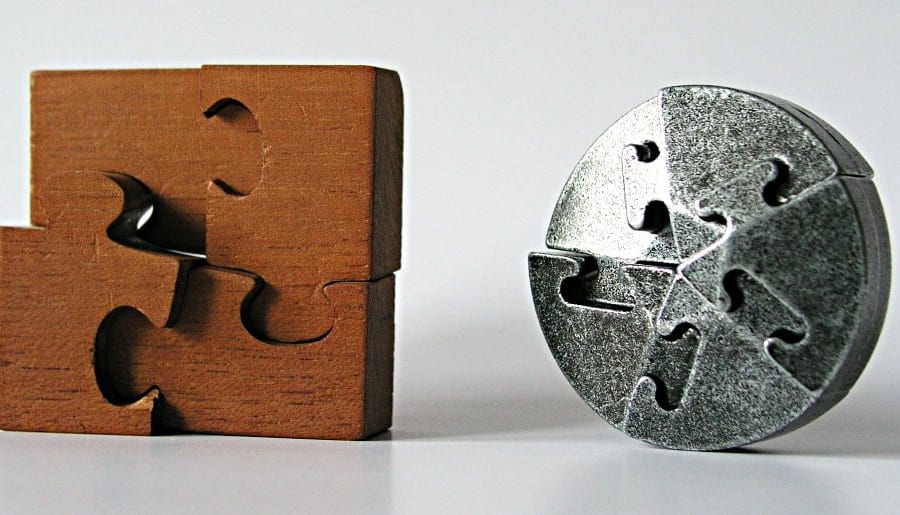
Wood, Metal, and Everything in Between: When it comes to collecting three-dimensional puzzles, there's a lot to choose from. Wooden burr puzzles and their many variations are a good place to start, especially if you enjoy figuring out how pieces fit together. Cast-metal puzzles, such as those made by Hanayama, offer a different kind of challenge, often involving carefully shaped pieces that need to be separated or repositioned. Both have their own appeal, and there's certainly no reason you can't collect a little of each.
The Art of Wooden Puzzles: If you spend much time exploring wooden mechanical puzzles, you'll probably come across the name Stewart Coffin. An American puzzle designer known for his intricate interlocking designs, Coffin created puzzles that are as impressive for their craftsmanship as they are for their clever solutions. Many feature beautiful geometric shapes made from carefully fitted pieces of wood. Original examples can be difficult to find and sometimes command high prices, but reproductions and designs inspired by his work offer other ways to appreciate his contributions to puzzle making.
Exploring Cast-Metal Puzzles: Hanayama is a great starting point for collecting cast-metal puzzles, but there's plenty more to discover. Companies such as Eureka and Recent Toys offer a variety of mechanical puzzles, although their collections aren't limited to cast metal. If you get more involved in the puzzle community, you might also encounter puzzles created for the International Puzzle Party, or IPP. These gatherings bring together designers and collectors from around the world, and some of the puzzles produced for their exchanges are particularly unusual or difficult to find.
Not every puzzle in your collection needs to be a brain-bender. Sometimes it's nice to have one you can actually solve before your coffee gets cold.
Timeline
Hanayama puzzles rated Levels 1 through 3 and simpler wooden burr puzzles are good places to begin. They'll introduce you to different types of mechanisms and help you get a feel for how mechanical puzzles work without being too overwhelming.
Once you've solved a few puzzles, you might want to try Hanayama Levels 4 and 5, more complicated burr designs, or packing puzzles. These often require a little more planning and experimentation, and they're a good way to discover which types of challenges you enjoy most.
Hanayama's Level 6 puzzles, more challenging Stewart Coffin designs, and selected IPP exchange puzzles can offer some serious challenges. By this point, you'll probably have a pretty good idea of what you enjoy collecting, along with a few puzzles that have been sitting unfinished on your desk for longer than you'd care to admit.
Some collectors eventually develop an interest in antique puzzles, limited-production designs, unusual interlocking mechanisms, or handcrafted pieces made by individual puzzle designers. These can be fascinating additions to a collection, especially if you enjoy learning about the people and techniques behind the puzzles.
Explore the other puzzle traditions.
The full puzzle history spans tavern puzzles, jigsaw puzzles, and the broader mechanical puzzle tradition.