

Other Puzzles
Sliding tiles, string and rope puzzles, sequential movement challenges, dexterity games, and plenty of others. Not every puzzle fits neatly into a category, and that's part of what makes exploring them so much fun.
More Than Three Kinds of Puzzles: We've already looked at tavern puzzles, three-dimensional mechanical puzzles, and jigsaws, but those are only part of what's out there. Puzzles come in an enormous variety of shapes, sizes, and styles, and some of the most entertaining ones don't fit comfortably into any of those groups. Just when you think you've seen every kind of puzzle, something completely different comes along.
A Little Bit of Everything: This section is where we'll explore some of those other puzzles. Some involve sliding pieces into position, others require a particular sequence of moves, and a few test your patience, coordination, or ability to think about a problem from a different angle. They don't necessarily have much in common beyond being puzzles, but that's exactly why I wanted to give them a place of their own.
Type I
Sequential Movement Puzzles
One Move at a Time

How Sequential Movement Puzzles Work: Sequential movement puzzles are all about getting pieces into the right positions by following a specific set of rules. Take the classic 15-puzzle, for example. You have fifteen numbered tiles in a square frame, with one empty space that allows you to slide the tiles around. The goal sounds simple enough: arrange the numbers in order. The catch is that you can't just pick up a tile and put it where you want. Every move affects what you can do next, and sometimes getting one piece into place means moving several others out of the way first.
More Mathematics Than You Might Expect: There's some fascinating mathematics behind these puzzles, even if you don't need to understand it to enjoy solving them. The Rubik's Cube, for example, has more than 43 quintillion possible arrangements, and every one that can be reached through normal turns can be solved in 20 moves or fewer. Of course, knowing that a short solution exists and actually finding it are two very different things. Mathematicians study these puzzles using ideas from group theory, but for most of us, the challenge is learning which moves work and figuring out when to use them.
Finding Your Way to a Solution: What I enjoy about sequential movement puzzles is how much they reward practice and experimentation. At first, you might find yourself moving pieces around and hoping everything eventually falls into place. But as you spend more time with a puzzle, you begin recognizing patterns and understanding how one move affects another. Some puzzles can be solved through careful trial and error, while others become much easier once you've learned a few useful techniques. There's something particularly satisfying about reaching the solution and realizing you actually understand how you got there.
The 15-puzzle has a particularly amusing bit of history: Sam Loyd became famous for challenging people to solve an arrangement that mathematics had already proved impossible. Sometimes the trick isn't finding the right moves. It's knowing whether the puzzle can be solved at all.
Timeline
The 15-puzzle becomes a sensation in the United States. Players slide numbered tiles around a square frame, trying to put them in order. The craze spreads quickly, and some arrangements prove much more frustrating than anyone expected. Although Sam Loyd later became closely associated with the puzzle, he wasn't its original inventor.
Mathematicians investigate why certain arrangements of the 15-puzzle cannot be solved. They show that only half of the possible tile arrangements can be reached through legal moves from a completed puzzle. It turns out that sometimes the problem isn't your technique. The puzzle really is impossible.
Hungarian architect and design professor Ernő Rubik creates the original Magic Cube, a twisting puzzle with movable sections that can rotate without falling apart. Solving the scrambled cube proves to be a challenge even for its inventor. His creation will eventually become one of the most recognizable puzzles in the world.
The Magic Cube reaches international markets under its new name, the Rubik's Cube. Its colorful design and surprisingly difficult challenge capture worldwide attention. Millions are sold, and the cube becomes a cultural phenomenon that introduces an enormous audience to twisting mechanical puzzles.
The first World Rubik's Cube Championship takes place in Budapest, Hungary. Competitors race to solve the familiar 3×3 cube, with American teenager Minh Thai winning in 22.95 seconds. Competitive speedcubing has come a long way since then, but this event remains an important milestone.
In 2010, researchers establish that any solvable 3×3 Rubik's Cube position can be completed in 20 moves or fewer when a 90-degree or 180-degree face turn counts as one move. This maximum is known as God's Number. In 2023, Max Park sets a then-world-record single-solve time of just 3.13 seconds, showing how far competitive cubing has progressed.
Type II
String & Rope Puzzles
Untangling the Impossible
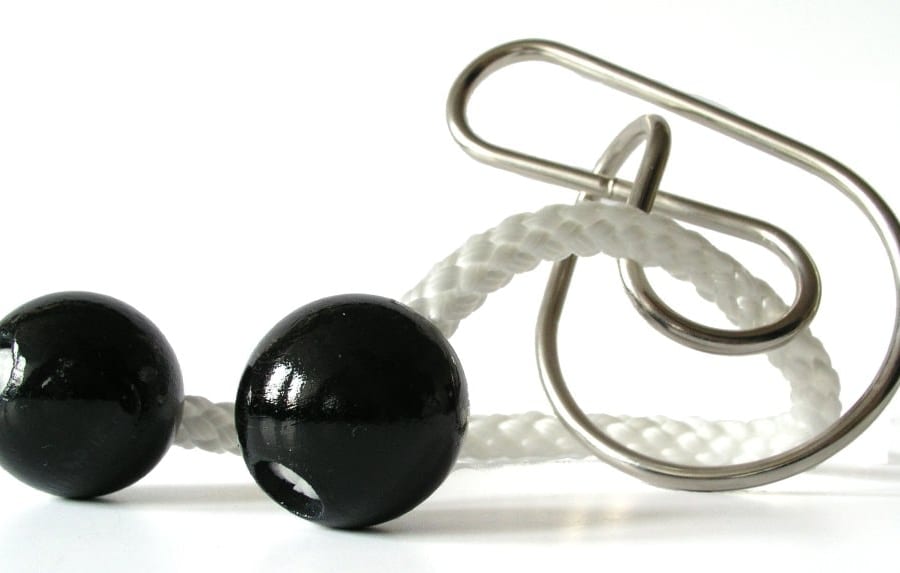
Simple Materials, Clever Challenges: String and rope puzzles have quite a bit in common with the metal disentanglement puzzles we've already explored. Both can involve loops, rings, and objects that seem permanently connected. The big difference is that string bends, twists, and folds, which opens up all sorts of possibilities. A puzzle that looks completely impossible at first might turn out to have a surprisingly simple solution once you figure out what that flexible piece of cord can actually do.
Getting Out of a Tangle: A typical string puzzle might have a loop of cord threaded through a wooden block, wrapped around a ring, or attached to another object. Your job is usually to separate something without cutting the string, untying a knot, or taking the puzzle apart. The trick often involves passing a loop through an opening, folding the cord back on itself, or looking at the arrangement from a different angle. These are the kinds of puzzles where you can spend twenty minutes trying increasingly complicated ideas, only to discover that the solution takes about five seconds once you know it.
The World of String Figures: String figures are another fascinating use of a simple loop of cord. Most of us are probably familiar with cat's cradle, where players pass a string arrangement back and forth between their hands. But there are many other traditions involving figures made with the fingers, some representing animals, familiar objects, or scenes from everyday life. They've been documented in cultures around the world, and they're interesting not just as recreational activities but also for the stories and traditions associated with them. Not every string figure is technically a puzzle, but they're certainly worth exploring.
Give someone a piece of string, a wooden block, and a couple of rings, and you might be surprised how long you can keep them entertained. Sometimes the simplest materials make the most frustrating puzzles.
Timeline
One of history's most famous knot stories comes from ancient Greek legend. The Gordian Knot was said to be so difficult to untie that whoever managed it would become ruler of Asia. Alexander the Great supposedly solved the problem by cutting through the knot with his sword. Whether that actually happened is another matter, but it's certainly one way to deal with a stubborn knot!
Knots, loops, and cords have been used for practical purposes and recreation in many cultures for centuries. Exactly when people began turning them into deliberate disentanglement puzzles is difficult to establish. What we do know is that a simple length of string can produce some surprisingly complicated challenges.
German mathematicians August Ferdinand Möbius and Johann Benedict Listing independently investigate a remarkable one-sided surface now commonly called the Möbius strip. Although it isn't a string puzzle itself, it's a wonderful example of how something that looks simple can behave in unexpected ways. Similar ideas about loops, surfaces, and connections help explain the mathematics behind certain disentanglement puzzles.
Puzzle writers such as Sam Loyd and Henry Dudeney help introduce readers to a wide variety of mechanical and mathematical challenges through newspapers, magazines, and books. Their collections include problems involving knots, loops, and objects that seem impossible to separate, giving curious readers plenty of opportunities to test their ingenuity.
Researchers and collectors document string-figure traditions from communities around the world. Familiar games such as cat's cradle are only part of a much larger family of designs made by manipulating loops of cord with the fingers. Some figures represent animals, people, or objects, while others are part of games, stories, or cultural traditions.
Type III
Dissection & Packing Puzzles
The Art of the Fit
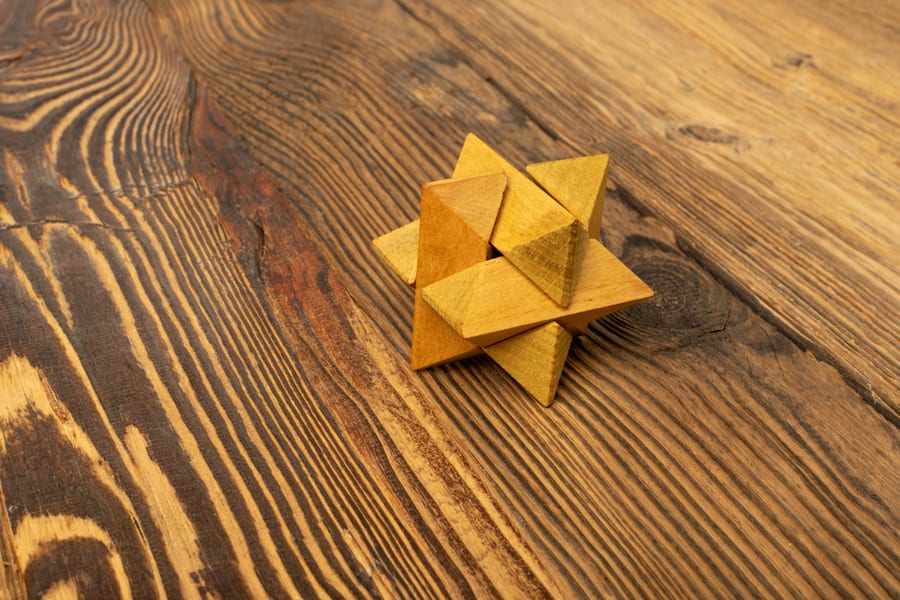
Two Different Ways to Fit Things Together: Dissection and packing puzzles are closely related, but they approach the challenge a little differently. In a dissection puzzle, you're usually trying to rearrange a set of pieces to create a particular shape. Packing puzzles ask you to fit a collection of pieces into a defined space, whether that's a flat outline, a box, or a three-dimensional structure. Both sound straightforward enough, especially when you can see all the pieces sitting on the table. Of course, that's usually when the trouble starts.
Seven Pieces, Countless Possibilities: The Tangram is probably the best-known example of a geometric dissection puzzle, and it's easy to see why it's remained popular for so long. You have seven pieces: five triangles, a square, and a parallelogram. By arranging them in different ways, you can create silhouettes of animals, people, buildings, and all sorts of other objects. Usually, the challenge is to recreate a particular outline using all seven pieces without overlapping them. It's a wonderfully simple idea, but some of those shapes are considerably harder to reproduce than they look.
Everything Fits... Eventually: Packing puzzles take that same idea and add the challenge of fitting everything into a particular space. The Soma Cube is a great example. It consists of seven irregular pieces that can be assembled into a 3×3×3 cube, and there are 240 distinct solutions when rotations and reflections of the completed cube aren't counted separately. You might think that having so many solutions would make it easy, but that doesn't necessarily help when you're staring at the last piece and wondering why it won't fit. Some packing puzzles have only one solution, and others can be impossible under certain conditions. Figuring out which situation you're dealing with is part of the fun.
The pieces are all there. The space is exactly the right size. Everything should fit. And yet, somehow, that last piece is still sitting on the table.
Timeline
The Tangram develops in China, although its exact origins remain uncertain. Made up of seven flat geometric pieces, it challenges players to arrange them into recognizable shapes and silhouettes. Its simple design allows for an impressive variety of figures, helping it become one of the world's best-known geometric puzzles.
Tangram puzzles and puzzle books spread from China to Europe and North America in the early 19th century. They quickly become fashionable entertainment, with people challenging one another to recreate increasingly complicated figures. The puzzle's popularity also inspires new books filled with designs for players to try.
British puzzle writer Henry Dudeney introduces a remarkable geometric challenge: cutting an equilateral triangle into four pieces that can be rearranged into a square. He later develops a hinged version that allows the pieces to fold from one shape into the other. It's a wonderful example of how a simple-looking puzzle can involve some surprisingly clever mathematics.
In the 1930s, Danish mathematician Piet Hein creates the Soma Cube, a puzzle made from seven pieces that can be assembled into a larger cube or other shapes. During the 1950s, mathematician Solomon Golomb helps popularize pentominoes, shapes formed from five connected squares. Both become enduring favorites among people who enjoy geometric and packing challenges.
Computers give puzzle designers powerful new ways to explore geometric arrangements and test possible solutions. Modern dissection and packing puzzles range from approachable wooden challenges to incredibly complicated designs that can keep even experienced solvers busy for hours. Some have many solutions, while others are carefully designed to have just one.
Type IV
Dexterity & Maze Puzzles
A Steady Hand and a Little Patience
When Your Hands Are the Challenge: Dexterity puzzles are a little different from most of the other puzzles we've explored. Instead of simply figuring out which piece goes where, you have to physically guide something into position. That might mean balancing a ball, tilting a maze, or carefully moving an object without disturbing anything around it. Knowing what you're supposed to do is usually the easy part. Actually doing it is where things get interesting, especially when one small mistake sends you right back to the beginning.
The Pigs in Clover Craze: One of my favorite stories from puzzle history involves Pigs in Clover, a handheld dexterity puzzle that became enormously popular in 1889. The objective was to maneuver four small balls through circular barriers and into the center. Simple enough, right? Apparently not. The puzzle became such a sensation that newspapers reported members of Congress spending time trying to solve it. Whether it actually interfered with government business is another question, but I can certainly understand how a frustrating little puzzle might become difficult to put down.
A Maze You Can Hold in Your Hands: Maze puzzles are especially interesting because they often combine physical coordination with a bit of planning. Take the classic wooden labyrinth, for example. You control the tilt of the playing surface using two knobs, guiding a steel ball through a winding path while trying to avoid the holes. You can see where the ball needs to go, but getting it there requires careful movements and a little anticipation. It's the kind of puzzle where you can make it almost to the finish, lose concentration for half a second, and find yourself starting all over again. Not that I've ever done that, of course.
In 1889, Pigs in Clover became so popular that even members of Congress were reportedly playing with it. I'd like to think they finished their work first, but I wouldn't bet on it.
Timeline
Small handheld dexterity puzzles become popular during the late 19th century. Many feature tiny balls, enclosed playing surfaces, and simple-looking objectives that turn out to be surprisingly difficult. Their compact size makes them easy to carry around, and they're an entertaining way to test your coordination and patience.
Charles Martin Crandall's Pigs in Clover becomes a national sensation in the United States. The challenge is to guide four small balls through a series of circular barriers into the center of a handheld puzzle. It becomes so popular that contemporary newspaper accounts even describe politicians in Washington becoming distracted by it. Apparently, puzzle fever isn't a recent invention.
Manufacturers continue producing a variety of handheld dexterity puzzles, including ball-in-hole games and small mazes. Some use simple printed illustrations, while others add obstacles, multiple targets, or more complicated paths. The basic idea remains the same: carefully move the pieces into position without letting them get away from you.
Tilting labyrinth games become familiar household toys during the 20th century. One particularly recognizable version uses a wooden playing surface controlled by two knobs, allowing players to guide a metal ball along a winding path while avoiding holes. It's an easy concept to understand, but getting that ball safely to the finish line takes practice.
Dexterity and maze puzzles continue to evolve, with designs ranging from traditional wooden labyrinths to elaborate three-dimensional ball mazes. Digital versions offer their own challenges, but physical puzzles still have something special about them. There's a certain satisfaction in controlling the movement yourself, even when the ball seems determined to go everywhere except where you want it.
Ready to try solving one?
The Guides section covers solving techniques and beginner tips for every puzzle type — including the ones on this page.
Explore the Guides